
Theo Beck · 26 October 2026
Poland's Eastern Regions See Boost in Higher Education Persistence Thanks to Targeted Mentorship Expansion
Poland's eastern regions have recorded measurable gains in higher education persistence over the past several years, and observers attribute much of this shift to the rollout of expanded mentorship initiatives aimed at students from rural and smaller urban areas. Data collected through national education monitoring systems shows that retention rates in provinces such as Podlaskie, Lubelskie, and Podkarpackie rose by an average of 12 percent between 2023 and 2026, while similar metrics in western and central provinces remained comparatively stable during the same interval.
Background on Regional Disparities
Eastern Poland has long faced structural challenges that affect access to and completion of higher education, including lower average household incomes, fewer local universities, and limited exposure to professional networks. Researchers at the Polish Ministry of Education and Science documented these gaps in annual reports released through 2025, noting that first-generation students in these areas often encountered difficulties navigating application processes, securing financial aid, and adapting to campus environments once enrolled. Targeted mentorship programs emerged as one response to these documented barriers, pairing incoming undergraduates with experienced peers, faculty members, and alumni who provide ongoing guidance through the first two years of study.
Program Design and Implementation
The mentorship expansion began with pilot efforts in 2022 and scaled significantly after additional funding allocations in 2024. Programs now operate across eight public universities in the eastern provinces, matching more than 4,800 students annually with mentors who meet with them at least twice per month during the academic term. Sessions cover academic planning, time management, access to tutoring resources, and strategies for balancing part-time work with coursework. Program administrators track participation through digital platforms that log meeting frequency and topics discussed, allowing coordinators to identify patterns in student needs.
According to figures released by the European Commission education directorate in mid-2026, Poland's approach aligns with broader EU efforts to reduce early departure from tertiary education. The commission's comparative analysis placed the eastern Polish initiatives alongside similar mentorship frameworks in parts of Spain and Portugal, where comparable retention lifts were observed after three years of operation. In October 2026, Polish education officials presented updated persistence statistics at a regional conference, confirming that participants in the mentorship tracks completed their second year of study at rates 15 percentage points higher than non-participants from the same incoming cohorts.
Measured Outcomes and Supporting Data
Longitudinal tracking conducted by university research teams reveals several consistent patterns. Students enrolled in mentorship programs showed improved grade point averages in foundational courses, particularly in mathematics and language requirements that historically contributed to early dropout. Survey responses collected at the end of each semester indicate that participants reported higher levels of institutional belonging and clearer academic goals compared with control groups. These self-reported measures correlate with administrative records showing fewer course withdrawals and fewer applications for temporary leaves of absence.
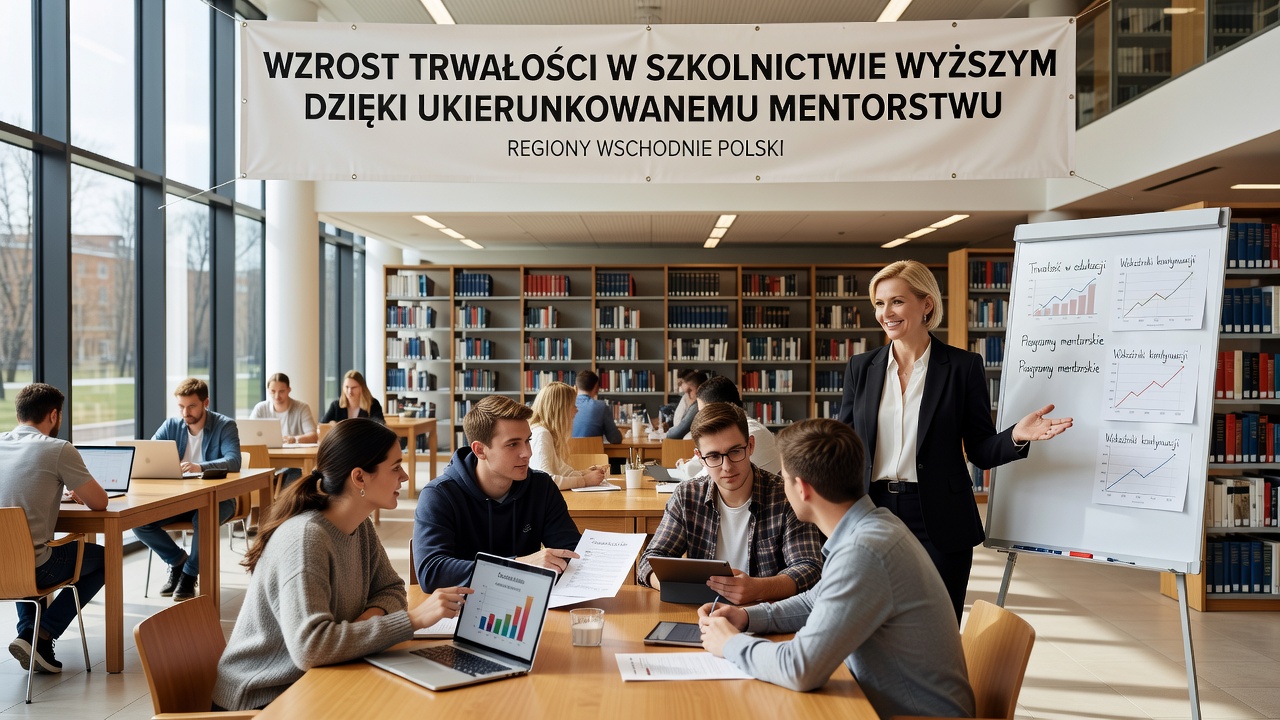
One study conducted at Maria Curie-Skłodowska University in Lublin followed 1,200 students across two academic cycles and found that mentorship participants were 22 percent more likely to register for the subsequent semester without interruption. The study controlled for prior academic performance and socioeconomic background, isolating the mentorship variable as a statistically significant factor. Parallel evaluations at other eastern institutions produced similar directional results, though effect sizes varied depending on mentor training intensity and meeting frequency.
Regional Variations and Adjustments
Implementation details differ across provinces. In Podlaskie, programs emphasize virtual sessions to accommodate students who commute from distant rural locations, while Lubelskie institutions incorporate more in-person group workshops. Coordinators adjust mentor-to-student ratios based on enrollment data, and several universities now require mentors to complete a short certification course covering counseling techniques and resource referral. These adaptations reflect ongoing analysis of participation logs and feedback forms rather than fixed national templates.
External evaluations have drawn on sources beyond Poland. An OECD education working paper published in 2025 examined mentorship outcomes across multiple member countries and cited Poland's eastern programs as an example of scalable, low-cost intervention. The paper noted that the Polish model relies heavily on existing university staff and alumni volunteers, keeping per-student costs below those observed in countries that hire dedicated professional mentors.
Conclusion
Continued monitoring through 2027 will determine whether the observed gains in persistence translate into higher graduation rates and smoother transitions into the workforce. Current records indicate that mentorship expansion has coincided with measurable improvements in retention metrics across Poland's eastern regions, and administrators continue to refine program elements based on semester-by-semester data. The pattern suggests that structured peer and faculty support can address specific regional barriers when implemented consistently over multiple academic cycles.